


VAMOS ESTUDAR UM POUQUINHO SOBRE PROTOCOLO DE SOBRECARGA DA ARTICULAÇÃO FEMOROPATELAR E FORÇA VERTIC
(You can find an English version of this post below)
A Força Vertical de Reação do Solo (FVRS) durante a fase de apoio do pé no chão direciona cargas que são transmitidas e absorvidas por todo o membro inferior do corpo humano. Os tecidos do corpo humano se adaptam frente as cargas aplicadas e quando expostos a cargas transmitidas em curtos períodos de tempo, ou seja, cargas produzidas rapidamente (chamamos isso de aumento da loading rate) a absorção é inadequada e prejudicial às articulações, inclusive à articulação femoropatelar (uma das articulações do joelho). Mulheres com Dor Femoropatelar (DFP) utilizam movimentos compensatórios para reduzir a dor durante suas atividades funcionais (como subida e descida de escadas). Esse comportamento pode dificultar a absorção das cargas e, portanto, resultar em aumento aplicação rápida de cargas quando o pé apoia o chão, ou seja, no aumento da loading rate da FVRS. Este estudo do nosso laboratório objetivou investigar, de forma inédita, o efeito imediato de um protocolo de sobrecarga sobre a articulação femoropatelar no nível de dor no joelho e na loading rate da FVRS em mulheres com DFP durante subida e descida de escada.
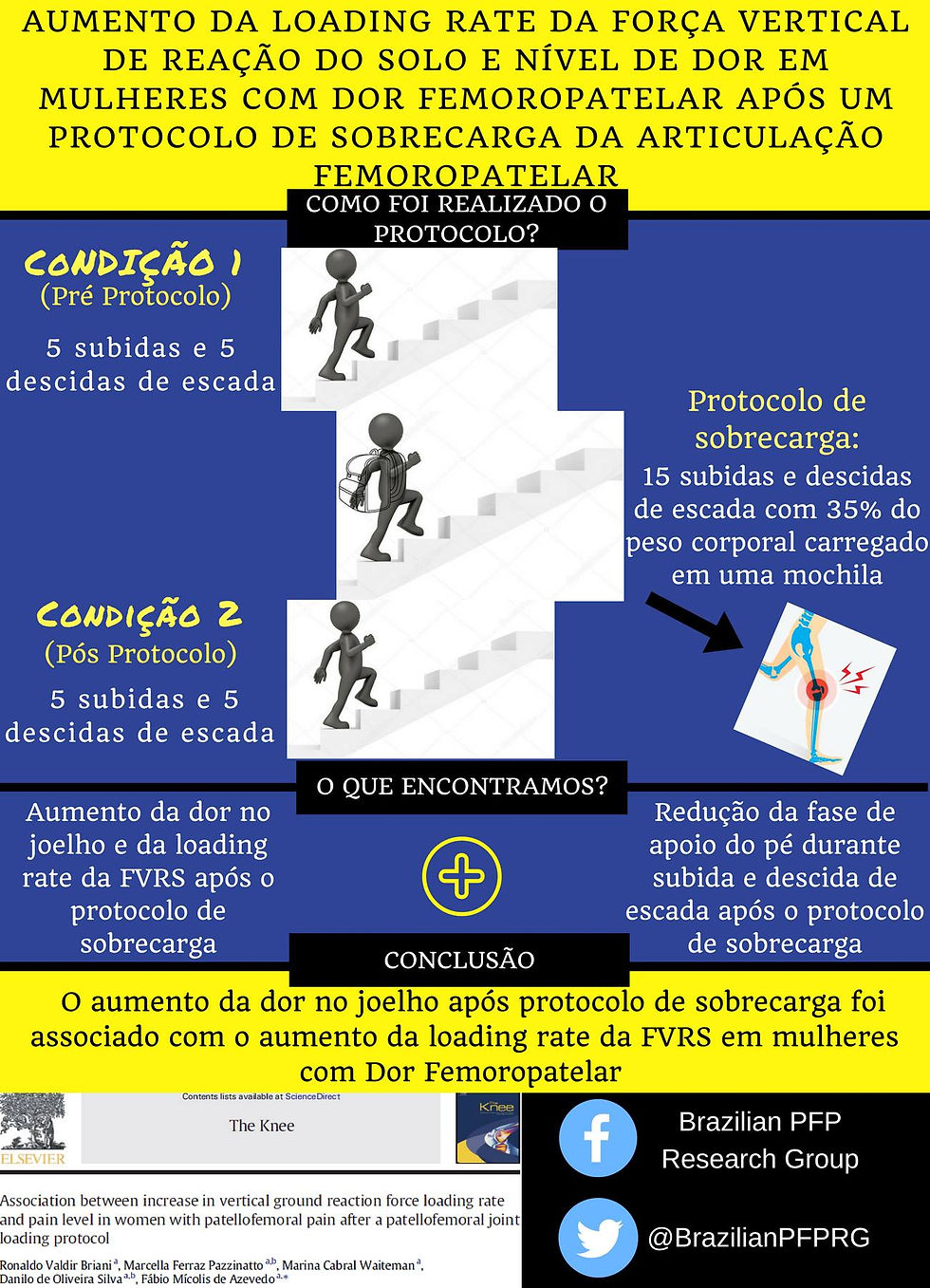
COMO FOI REALIZADO O PROTOCOLO? 34 mulheres com DFP foram convidadas para participar da pesquisa e distribuídas aleatoriamente em dois grupos denominados Condição 1 e Condição 2:
Condição 1 (Pré Protocolo): Assim que chegavam no laboratório era questionado a cada participante o nível de dor que estavam sentindo naquele momento. Em seguida, para coleta dos dados, cada participante foi orientada a realizar 5 subidas e 5 descidas de escada.
Condição 2 (Pós Protocolo): Antes de ser questionado o nível de dor que estavam sentindo naquele momento, as participantes foram submetidas a um protocolo de sobrecarga sobre a AFP* com o objetivo de exacerbar os sintomas no joelho delas. Em seguida, para coleta dos dados, cada participante foi orientada a realizar 5 subidas e 5 descidas de escada.
*Protocolo de sobrecarga: 15 repetições de subida e descida de escada com 35% do peso corporal de cada uma delas carregado em uma mochila.
O QUE ENCONTRAMOS? • Após o protocolo de sobrecarga a dor no joelho aumentou em mulheres com DFP; • Após o protocolo de sobrecarga a loading rate da FVRS aumentou; • Após o protocolo de sobrecarga o tempo de apoio do pé durante a subida e descida das escadas foi reduzido.
O QUE ISSO SIGNIFICA? Altas cargas aplicadas rapidamente e não absorvidas corretamente, ou seja, altas loading rates da FVRS, podem sobrecarregar a articulação femoropatelar e levar ao aumento da dor no joelho durante atividades funcionais (subida e descida de escada) em mulheres com DFP.
PRINCIPAL MENSAGEM DO ESTUDO: O aumento da dor no joelho após protocolo de sobrecarga foi associado com o aumento da loading rate da FVRS em mulheres com Dor Femoropatelar.
Para maiores informações veja o texto abaixo:
BRIANI, R. V. et al. Association between increase in vertical ground reaction force loading rate and pain level in women with patellofemoral pain after a patellofemoral joint loading protocol. Knee, 2018. https://doi.org/10.1016/j.knee.2018.03.009
INCREASE IN VERTICAL GROUND REACTION FORCE LOADING RATE AND PAIN LEVEL IN WOMEN WITH PATELLOFEMORAL PAIN AFTER A PATELLOFEMORAL JOINT LOADING PROTOCOL
During the stance phase of the gait, the Vertical Ground Reaction Force (VGRF) guide the forces that are transmitted and absorbed throughout the lower limb of the human body. The body tissues adapt to the forces applied. When exposed to forces in short periods of time, such as forces produced quickly (i.e. higher loading rates), inadequate force absorption may lead damage lower limb joints, including the patellofemoral joint. Women with Patellofemoral Pain (PFP) use compensatory movements in order reduce pain during functional tasks (such as stair negotiation). This behavior may compromise force absorption and increase the rapid application of forces during stance phase of the gait, consequently increasing the loading rate of the VGRF. This study of our laboratory aimed to investigate the immediate effect of a patellofemoral joint (PFJ) loading protocol in the level of pain and VGRF loading rate in women with PFP during stair negotiation.
HOW WAS THE PROTOCOL PERFORMED? 34 women with PFP were randomized to 2 conditions:
Condition 1 (Pre Protocol): as soon as they arrived at the laboratory all participants were asked to rate their knee pain, indicating the amount of pain they were feeling at the moment. Then, each participant was asked to perform five repetitions of stair ascent and descent.
Condition 2 (Post Protocol): Participants were asked to perform a PFJ loading protocol*, in order to load their PFJ. Then, each participant was asked to perform five repetitions of stair ascent and descent.
PFJ loading protocol: 15 repetitions of stair negotiation with 35% external load of the subject's body mass carried in a backpack.
WHAT DO WE FOUND? • After PFJ loading protocol: knee pain increased in women with PFP; • After PFJ loading protocol: the VGRF loading rate increased in women with PFP; • After PFJ loading protocol: the stance time decreased during stair negotiation.
WHAT DOES THAT MEAN? The application of high forces and the inadequate absorption (i.e. higher VGRF loading rates), can compromise the lower limb joints and lead to increase of knee pain during functional tasks in women with PFP.
TAKE HOME MESSAGE: Increase in pain after PFJ loading protocol was associated with the increase in VGRF loading rates in women with PFP.
For more information see the text below:
BRIANI, R. V. et al. Association between increase in vertical ground reaction force loading rate and pain level in women with patellofemoral pain after a patellofemoral joint loading protocol. Knee, 2018. https://doi.org/10.1016/j.knee.2018.03.009

Comentários